culture
🏰 Québec City
📍 Canada · North America
📍 Canada · North America
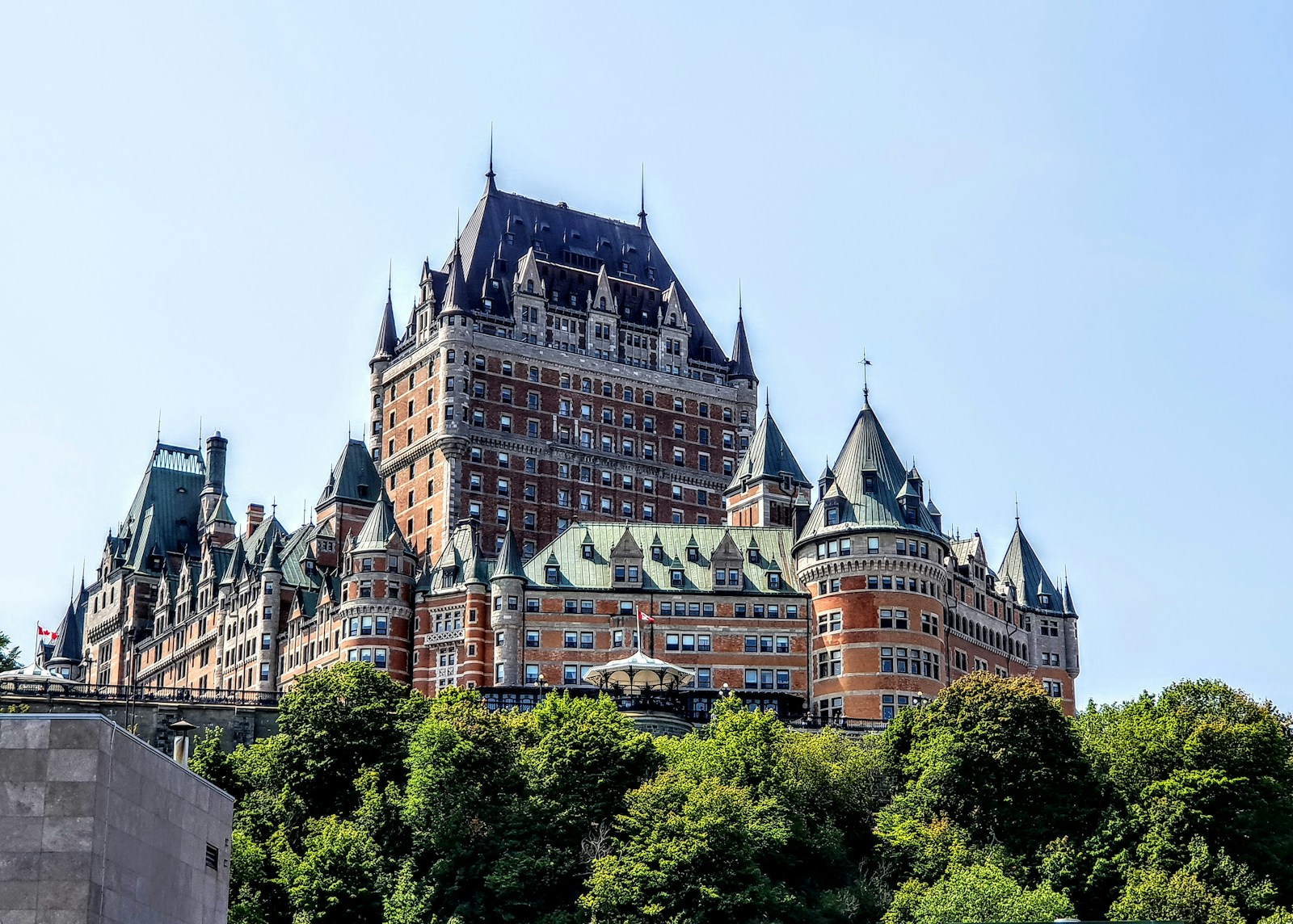
🏛 Château Frontenac
Québec City is the only walled city north of Mexico, its 4.6 kilometres of stone ramparts encircling the old upper town (Haute-Ville) that sits on Cape Diamond above the St. Lawrence River. The UNESCO World Heritage Site designation encompasses both the Upper Town and Lower Town (Basse-Ville), preserving a French colonial cityscape of extraordinary completeness — stone walls, copper-roofed churches, narrow lanes, and the Château Frontenac rising above everything in a silhouette that has made it the most photographed hotel in the world. Founded in 1608 by Samuel de Champlain, Québec City is the oldest continuously inhabited French settlement in North America and the cradle of French civilisation on the continent.
The Château Frontenac was built by the Canadian Pacific Railway in 1893 as the most luxurious hotel in Canada — its turreted profile commands the entire river panorama from every angle. The Dufferin Terrace, a wide wooden boardwalk that runs along the cliff face below the Château, offers one of the finest promenade views in Canada: the St. Lawrence River nearly three kilometres wide, the Île d'Orléans in midstream, and the Laurentian Mountains rising beyond the south shore. The Funicular connecting the Terrace to the Rue du Petit-Champlain below has operated since 1879, descending through the cliff face to the oldest commercial street in North America — a cobblestone lane of boutiques and bistros that feels genuinely European.
The Québec Winter Carnival, running for two weeks in late January and early February, is the largest winter festival in the world — centred on the famous ice palace built anew each year and animated by Bonhomme Carnaval, the snowman mascot that has presided since 1954. Ice canoe racing across the partially frozen St. Lawrence, night parades, snow sculptures of extraordinary artistry, and the tradition of drinking caribou (a fortified wine and spirits mix) from plastic canes fill the city with hundreds of thousands of visitors who have willingly chosen to be very cold and very happy simultaneously. Summer brings the Festival d'Été de Québec, one of the largest outdoor music festivals in North America.
The Plains of Abraham, now an urban park above the St. Lawrence, is the most historically significant battlefield in Canadian history — where in 1759 the British under General Wolfe defeated the French under Marquis de Montcalm in a 15-minute engagement that effectively ended French control of North America. The Musée national des beaux-arts du Québec anchors the park's cultural life with the finest collection of Québécois art anywhere. The walled city beyond the ramparts extends into the Grande Allée — a boulevard of Victorian mansions converted to restaurants with enormous summer terrasses that serve as the true living room of Québécois public life.
Winter festival travellers, anyone who wants the most authentically French-Canadian experience in North America, history enthusiasts, and couples looking for a genuinely romantic Canadian city break.
Compare prices and book your trip — hotels, flights, and guided tours.
* Links open partner sites. We may earn a commission at no extra cost to you. See our editorial policy.