culture
🛶 Lake Titicaca
📍 Peru / Bolivia · South America
📍 Peru / Bolivia · South America
🏛 Uros Floating Reed Islands
Lake Titicaca is the world's highest navigable lake — 190 kilometres long and 80 kilometres wide at 3,812 metres above sea level on the Andean altiplano between Peru and Bolivia. The lake's altitude and the intense ultraviolet radiation at this elevation give its waters an extraordinary deep blue colour — at once Mediterranean and alien, surrounded by snowcapped peaks and treeless high-altitude grassland. For the Inca civilisation, Titicaca was the sacred origin point of the world: their creation mythology held that the sun god Inti emerged from the lake's waters at the beginning of time, and the island of Isla del Sol was the birthplace of the first Inca.
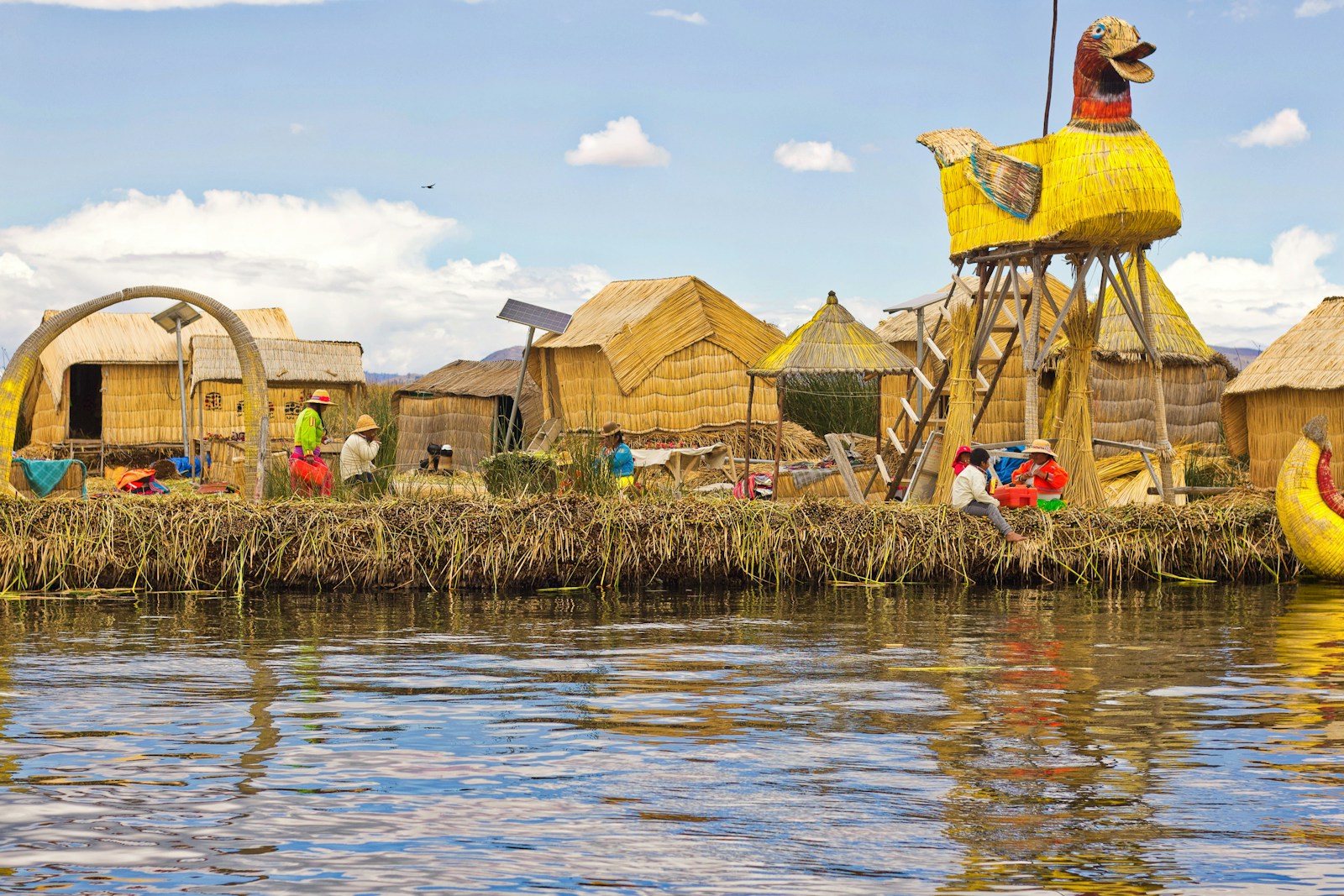
The floating islands of the Uros people are the lake's most immediately striking feature. Around 70 island platforms, each roughly the size of a tennis court and home to two to ten families, are constructed entirely from totora reed — the buoyant marsh grass that grows in Titicaca's shallows. The islands are built up in layers from the lake bottom to a depth of up to 2 metres; as the lower layers decompose, new totora is added on top, requiring continuous maintenance. Houses, boats, solar panels, and watchtowers are all constructed from the same material. The Uros have lived on the lake in this manner for centuries, originally to avoid Inca subjugation — moving their floating islands to safety if threatened.
Isla del Sol on the Bolivian side is the lake's most rewarding island for those willing to spend a night. The island has no cars and no roads — only stone pathways between villages perched on terraced hillsides. Inca ruins are scattered across both the northern and southern tips of the island; the Fountain of Youth (an Inca spring with carved stonework), the Palace of the Inca, and the Sacred Rock are accessible on foot in a full-day circuit. The sunsets from the hilltop villages, with the deep blue lake stretching to the Bolivian and Peruvian shore mountains in every direction, are exceptional.
Practical planning: Base in Puno on the Peruvian side for easy access to the Uros islands and Taquile. Base in Copacabana on the Bolivian side for Isla del Sol ferries. Altitude at 3,812m means acclimatisation in Cusco or Puno is strongly recommended before arrival. Altitude sickness (headache, nausea, breathlessness) is common in the first 24 hours; go slow, drink water, avoid alcohol. Best time May to October (dry season). The lake crossing between Peru and Bolivia — by bus via the Desaguadero border — is straightforward but takes a full day.
Compare prices and book your trip — hotels, flights, and guided tours.
* Links open partner sites. We may earn a commission at no extra cost to you. See our editorial policy.